Ends the Pain Source
When a tooth is broken beyond repair or badly infected, removing it resolves the pain at its origin rather than managing it with antibiotics and painkillers indefinitely.
Oral Surgery
When a tooth genuinely cannot be saved, removal should be calm, numb, and well explained. Simple and surgical extractions with Dr. Richard Baldwin, DMD.

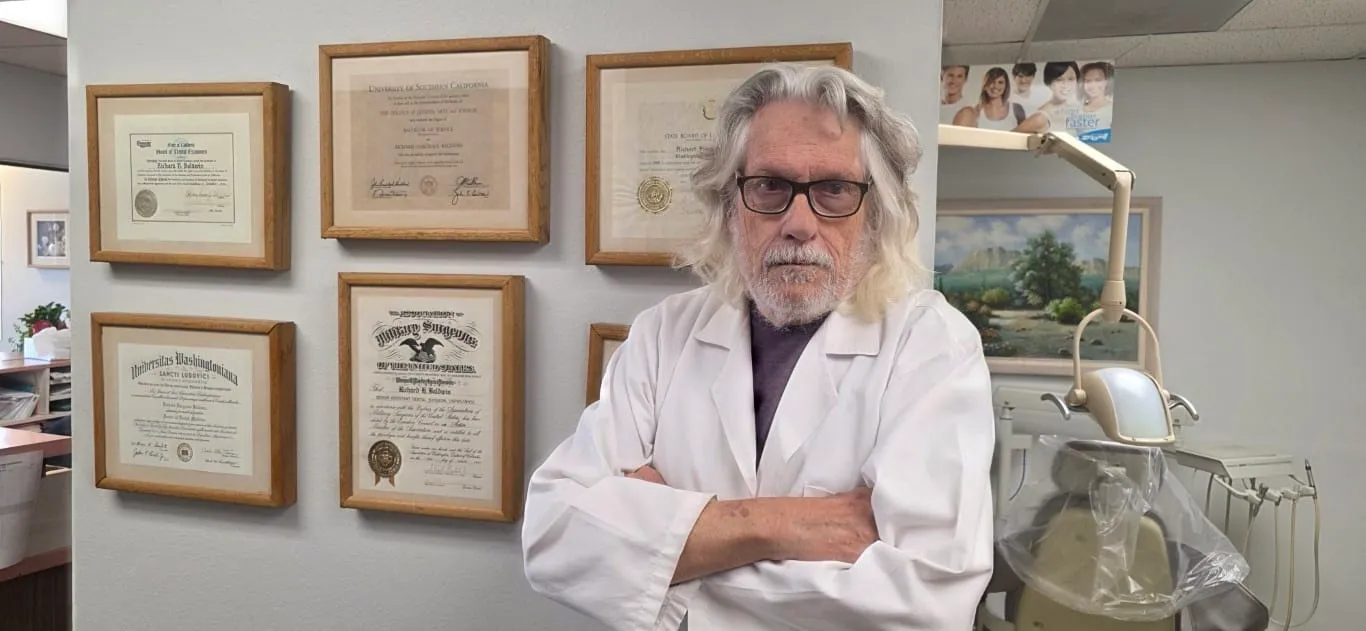 Dr. Richard Baldwin, DMDYour Huntington Beach dentist since 1979
 Save 25–50% on your first visit — up to $500 off. The discount applies to any service we offer, from cleanings and Invisalign to crowns and implants.
What's included
New patients only · Not valid with dental insurance · Maximum $500 discount per patient · Cannot combine with other offers
Disclaimer: Discount applies to treatment fees only and is capped at $500 per patient. Available to new patients without dental insurance and cannot be combined with other offers or insurance benefits. Your exact discount is confirmed in writing after your exam and before treatment begins.
Dr. Baldwin has practised in Huntington Beach since 1979, and the approach to extraction has not changed in that time: a tooth comes out when it genuinely cannot be saved, and not before. Severe decay that has destroyed too much structure, a fracture running below the gumline, advanced gum disease that has taken the supporting bone, or an impacted tooth crowding its neighbours — those are real reasons. Before recommending removal we tell you whether a root canal and crown could save it instead, and what each path costs.
A tooth extraction in Huntington Beach at our office is done under local anesthesia, which is what actually blocks pain — you feel firm pressure and movement rather than discomfort. Our office does not provide sedation; cases that genuinely need it are referred to an oral surgeon. What matters most for your comfort afterward is the first 72 hours, because that is the window in which dry socket develops. Read our extraction recovery guide and our guide to wisdom teeth removal.
Normal extraction soreness improves a little each day. Pain that suddenly gets worse around day three is the signature of dry socket — and that is a phone call, not something to wait out.
Why removal is sometimes genuinely the right call — and what we do to make it straightforward.

When a tooth is broken beyond repair or badly infected, removing it resolves the pain at its origin rather than managing it with antibiotics and painkillers indefinitely.
A severely infected tooth can spread bacteria into surrounding bone and soft tissue. Removing the source stops that progression.
Simple and most surgical extractions are done under local anesthesia. You are numb, awake, and able to drive yourself home afterward.
Impacted or crowded teeth push against their neighbours and trap bacteria in places you cannot clean. Removing them protects the teeth beside them.
You leave knowing exactly what to do and what to avoid for the first 72 hours — the window that determines whether healing goes smoothly.
For any tooth that shows when you smile or chew, we discuss replacement options before the extraction, not after you have lived with the gap.
From the X-ray that decides whether the tooth can be saved through to the healing check.
Dr. Baldwin examines the tooth and takes an X-ray to see the root shape, how close the roots sit to the nerve or sinus, and whether the tooth can realistically be saved. Extraction is the last option, not the first.
If a root canal and crown could save the tooth, we tell you that and price both paths. Some teeth genuinely cannot be saved — but you should hear the alternatives before deciding.
Local anesthetic fully numbs the tooth and surrounding tissue. We wait until it has genuinely taken effect and check with you before starting — this step is not rushed.
A simple extraction loosens and lifts out a fully erupted tooth. A surgical extraction involves a small incision, and sometimes the tooth is sectioned into pieces for easier removal. You feel firm pressure, not pain.
Gauze pressure for 30–45 minutes lets a blood clot form in the socket. That clot is what protects the bone underneath — we explain exactly how to keep it in place.
Gum tissue closes over the socket within two to three weeks; the bone underneath fills in over several months. We check the site and remove any non-dissolving stitches.
Dry socket is the complication people worry about most, and it is worth understanding properly. After an extraction a blood clot forms in the socket and shields the exposed bone and nerve endings while healing begins. If that clot is dislodged or breaks down too early, the bone is left uncovered — which is intensely painful.
The distinguishing feature is the timing. Normal soreness improves a little every day. Dry socket pain arrives suddenly around day three, feels sharp rather than dull, and often radiates toward the ear or temple on that side. It is straightforward for us to treat with a medicated dressing, so call rather than waiting it out.
A simple extraction applies when the tooth has fully erupted and can be reached directly. The tooth is loosened with an instrument and lifted out. This often takes only a few minutes once you are numb.
A surgical extraction is needed when the tooth is broken at the gumline or partly buried in bone. A small incision gives access, and the tooth is sometimes sectioned into pieces so it can come out through a smaller opening — which is gentler on the surrounding bone than forcing it whole. Dissolving stitches close the site.
Deeply impacted teeth, roots sitting very close to the nerve, and cases better managed with sedation go to an oral surgeon. Our office does not offer sedation, and referring those cases out is the right call rather than a limitation.
Extraction cost depends on whether the tooth needs a simple or a surgical removal. A fully erupted tooth that lifts out straightforwardly costs considerably less than one broken at the gumline that requires an incision and sectioning. Most dental plans cover extractions as a basic restorative procedure.
We give you the figure after the X-ray, once we can see the root shape and know which type of extraction your tooth actually needs.
Call our Huntington Beach office at (714) 536-2571 and we will verify your benefits before treatment.
Everything you need to know about tooth extraction at our Huntington Beach practice.
Dry socket happens when the blood clot in the extraction site is dislodged or dissolves too early, exposing the bone and nerve endings underneath. It causes a sharp, radiating pain that typically starts two to four days after the extraction — noticeably worse than the steadily improving soreness of normal healing. To avoid it: do not smoke for at least 72 hours, do not drink through a straw for the first week, avoid forceful spitting or rinsing for 24 hours, and stick to soft foods. Smoking is by far the biggest risk factor.
Instead of a dark red blood clot filling the socket, you may see an empty-looking hollow with whitish bone visible at the base. There is often a bad taste or odour with it. The most reliable sign is the pain pattern rather than the appearance — normal extraction discomfort improves each day, while dry socket pain suddenly worsens around day three and often radiates toward the ear or temple. If that describes your pain, call us; it is straightforward to treat with a medicated dressing.
Yes. If you have a severely broken or infected tooth causing significant pain, call our Huntington Beach office at (714) 536-2571 as early in the day as you can and we will do our best to see you the same day when availability permits. Call ahead rather than walking in, so we can prepare for you and give you accurate guidance in the meantime.
The extraction itself should not hurt. The area is fully numbed with local anesthesia first, and what you feel is firm pressure and movement rather than pain. Afterward, expect soreness for a few days that is normally well controlled with over-the-counter ibuprofen. Take the first dose before the numbness fully wears off — it is much easier to stay ahead of the discomfort than to catch up with it.
Most people feel substantially better within three to four days and return to normal routines quickly. Swelling typically peaks around day two or three, then improves. The gum tissue closes over the socket in about two to three weeks, while the bone underneath fills in gradually over several months. Surgical extractions take somewhat longer to settle than simple ones.
Stick to soft, cool foods for the first few days — yogurt, applesauce, smoothies eaten with a spoon rather than a straw, mashed potatoes, scrambled eggs, and lukewarm soups. Avoid anything crunchy, spicy, very hot, or containing small seeds and grains that can lodge in the socket. Chew on the opposite side. Most patients return to a normal diet within about a week.
For back molars that do nothing visible, sometimes no replacement is needed. But when a tooth is removed the neighbouring teeth tend to drift toward the gap and the opposing tooth can over-erupt, which changes your bite over time. The jawbone in that area also gradually resorbs without a root stimulating it. We discuss replacement options — including implants, which we plan and restore while an oral surgeon places them, as well as bridges and partial dentures — before the extraction rather than after.
We handle many wisdom tooth extractions here at our Huntington Beach office. Deeply impacted teeth, roots sitting very close to the nerve, or cases that would be better managed with sedation are referred to an oral surgeon — our office does not provide sedation. Dr. Baldwin reviews your X-ray and tells you plainly which category your case falls into.
Yes. We use local anesthesia only, which numbs the area without affecting your alertness, so you are safe to drive afterward. It is worth arranging a lift only if you would simply feel more comfortable that way.
Call us if pain suddenly worsens after day three rather than improving, if bleeding does not settle with gauze pressure, if swelling increases after day three, if you develop a fever, or if you cannot open your mouth normally. Steadily improving soreness is expected — worsening symptoms are not, and they are much easier to treat early.
Written and clinically reviewed by Dr. Richard Baldwin, DMD General & cosmetic dentist in Huntington Beach since 1979 · Washington University School of Dental Medicine · Updated
This page is general dental information from a practicing dentist, not a diagnosis. Treatment recommendations and costs are confirmed at an in-person exam.
If a tooth is badly broken or infected, call our Huntington Beach office early in the day and we will do our best to see you the same day. Dr. Baldwin will tell you honestly whether the tooth can be saved.
Serving Huntington Beach, Fountain Valley, Westminster, Costa Mesa, Seal Beach, Santa Ana, Anaheim, Newport Beach, Long Beach, Irvine & Tustin
Expert tips and insights to keep your smile healthy and bright.
 Sep 23, 2026
 Not everyone needs wisdom teeth removed. Learn the signs, what the procedure involves, and recovery tips from Dr. Baldwin.
Read Article Sep 13, 2026
 What dry socket feels like, why it happens after a tooth extraction, how a Huntington Beach dentist treats it, and the five habits that prevent it.
Read Article Aug 23, 2026 Recovery after tooth extraction follows a predictable timeline. Learn the best foods, pain management tips, and what to avoid for fastest healing.
Read Article