Jump to a section
- Why “Dental Implants Near Me” Search Results Can Be Misleading
- Credentials That Actually Matter for Implant Placement
- The Technology Every Modern Implant Practice Should Have
- Questions to Ask at Your Implant Consultation
- Red Flags to Walk Away From
- Why Local Follow-Up Care Matters After Your Implant
- Frequently Asked Questions
Searching dental implants near me on your phone gives you a list of pins on a map. It does not tell you which of those practices places implants every week and which places one every few months. If you live in Huntington Beach, Fountain Valley, or anywhere in coastal Orange County, this guide breaks down what actually separates a competent local implant dentist from a nearest-pin gamble — the credentials, the technology, the consultation questions, and the red flags.
Why “Dental Implants Near Me” Search Results Can Be Misleading
Google’s local map results are ranked on proximity, review count, and profile completeness — not on how many implants a dentist actually places. A general dentist who has placed six implants in a decade can rank next to a clinician who places six a week. Both show up when you search dental implants near me, and neither result tells you which is which.
The distinction matters because implant success depends on repetition. Peer-reviewed studies consistently show that clinicians who place more than fifty implants per year have measurably lower complication rates than those who place fewer than ten. The map does not surface volume. The Google review count does not either — a dentist can accumulate hundreds of positive reviews for routine cleanings while quietly outsourcing every complex implant case.
For a starting point on what a full implant procedure actually involves, our overview of the dental implant process at HB Dentist walks through the consult, imaging, surgery, and healing phases.
Credentials That Actually Matter for Implant Placement
A DDS or DMD is the baseline license every dentist holds — it does not indicate implant training. Look for these additional signals:
- Continuing education in implantology. Organizations like the American Academy of Implant Dentistry (AAID), the International Congress of Oral Implantologists (ICOI), and the Misch International Implant Institute offer structured multi-year fellowships. Credentialing through one of these tells you the dentist has invested serious time beyond dental school.
- Case volume, not just years in practice. Ask how many implants the dentist personally places each year. A conservative baseline is fifty per year; experienced clinicians often place several hundred.
- In-house or trusted-lab restoration. The dentist who places the implant should either restore it themselves or work with a specific lab and prosthodontist so the final crown fits the exact angle of the implant.
Dr. Baldwin has been planning and restoring implants in Huntington Beach for decades, working alongside a trusted oral surgeon who handles placement. You can review his full credentials on our meet the doctor page. Longevity paired with active continuing education is the combination worth looking for in any local implant dentist.
The Technology Every Modern Implant Practice Should Have
Implant dentistry has changed more in the last decade than in the previous four combined. When you tour a practice — physically or through their website — verify they use:
- 3D cone-beam CT (CBCT) imaging. A 2D X-ray cannot show the nerve position, sinus floor, or three-dimensional bone volume in your jaw. Any implant plan built on a flat X-ray alone is guessing.
- Guided surgery software. Digital planning lets the dentist virtually place the implant before touching a scalpel and, in many cases, use a 3D-printed surgical guide to execute the plan within a fraction of a millimeter.
- Documented implant material sourcing. The specific implant brand and titanium grade should be listed in your treatment plan. Discount overseas implants without material certificates carry higher failure and revision rates.
If you want to understand why the material specification matters, our companion guide on medical-grade titanium dental implants covers the metallurgy in plain English.
Questions to Ask at Your Implant Consultation
Every reputable local implant dentist will welcome direct questions. Bring this short list to your consult:
- How many implants do you personally place each year?
- What imaging will you use to plan my case?
- What implant system do you use, and why?
- What is the fully loaded dental implants cost — surgery, abutment, crown, follow-up?
- What happens if the implant fails, and is it covered under any warranty?
- Who restores the implant, and where is the lab that fabricates my crown?
- How many follow-up visits are included in the quoted price?
If the dentist dodges any of these — especially the cost question — walk out. Cost transparency is table stakes. For context on the full price range in this market, our Huntington Beach implant cost breakdown explains what drives the number. The American Dental Association’s consumer implant guide is another neutral resource worth reading before your consult.
Red Flags to Walk Away From
Some warning signs are easy to spot once you know what to look for:
- Pressure to decide today. Same-day discounts on a $4,000+ procedure are a sales tactic, not a clinical reason to commit.
- No 3D imaging in the treatment plan. If the dentist plans your implant from a panoramic X-ray, they are working with incomplete information.
- Prices dramatically below market. In the Orange County area, single-tooth implants generally fall between $3,500 and $6,500 including the crown. Bids below that range often use uncertified implants, skip the abutment cost, or exclude the crown entirely.
- Vague warranty language. “We stand behind our work” is not a warranty. Ask for the terms in writing.
- No referral network for complex cases. Even experienced generalists refer out for full-arch reconstructions requiring an oral surgeon or periodontist. A dentist who claims to do everything alone should raise a flag.
Why Local Follow-Up Care Matters After Your Implant
The surgery itself is one day. Osseointegration takes three to six months. Regular maintenance visits continue for the life of the implant. That timeline is why “local” in dental implants near me is not just about the initial drive — it is about the twenty years of care that follow.
Choosing a practice thirty minutes from home rather than five minutes matters when you need a torque check on an abutment screw, want a quick look at a slightly loose crown, or face an unrelated dental emergency. Continuity of care with a single practice that has your original CBCT scans, surgical notes, and prosthetic specifications on file also protects you if something needs adjustment years later.
For a sense of the maintenance timeline you should plan for, our guide on how long dental implants last covers what an implant needs at year one, year five, and year fifteen.
Frequently Asked Questions
How far should I be willing to travel for a dental implant?
Most patients are willing to drive 30 to 45 minutes for an experienced implant dentist. Because implant care extends over months and includes maintenance visits for years, choose a practice you can realistically reach for a two-hour appointment without disrupting your day.
What credentials should a dentist have to place implants?
Every dentist can legally place implants after dental school, but look for additional signals: fellowship or mastership in the AAID or ICOI, continuing education through Misch or Pikos institutes, and a track record of placing at least fifty implants per year.
Are local dental implants more expensive than driving farther?
Local implant costs in Huntington Beach and Orange County are generally in line with the national average — $3,500 to $6,500 per single-tooth implant with the crown. Driving to Mexico or a discount practice can lower the sticker price, but typically shifts risk onto the patient if complications arise.
How many implants should my dentist have placed to be proficient?
Complication rates decline sharply once a clinician passes about 100 lifetime placements and continues placing at least 50 per year. Ask about both lifetime and annual volume — both numbers matter.
What technology should my local implant dentist have on-site?
At minimum: 3D cone-beam CT imaging, digital intraoral scanning, and either in-house or partnered CAD/CAM crown fabrication. Guided surgery capability is a strong plus, especially for full-arch cases.
Ready to see what an experienced local implant dentist looks like in practice? Schedule your consultation at HB Dentist in Huntington Beach — Dr. Baldwin will review your imaging, discuss material options, and give you a straightforward plan and price.
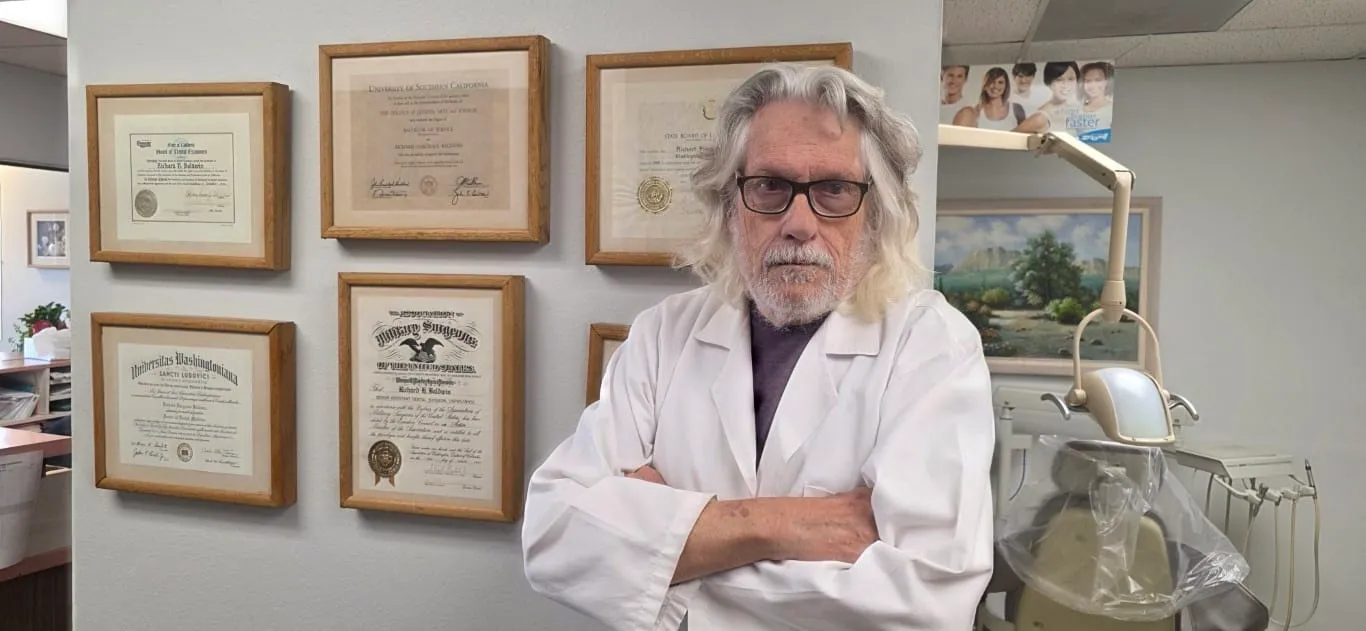
Written and clinically reviewed by Dr. Richard Baldwin, DMD General & cosmetic dentist in Huntington Beach since 1979 · Washington University School of Dental Medicine · Updated
Sources & further reading
- Dental implants — American Dental Association · MouthHealthy
- Dental implant surgery — American Association of Oral and Maxillofacial Surgeons
- Gum disease and implant health — American Academy of Periodontology
This guide is general dental information from a practicing dentist, not a diagnosis. Treatment recommendations and costs are confirmed at an in-person exam.